Real Estate Math Formulas & Practice Questions: The Complete Arizona Exam Guide (2026)
Becoming an Agent

Math is the part of the Arizona real estate exam most candidates dread—and the part most within your control. Unlike the vocabulary and statutory sections, every math question on the Pearson VUE exam follows a predictable format with a finite set of formulas. Learn the formulas, practice the question types, and math becomes a reliable source of guaranteed points.
This guide covers every math category tested on the Arizona exam—with the formula, a worked example using real Scottsdale market numbers, and two practice questions each. It also includes a printable cheat sheet covering every formula you need, and the Memory Circle—ASREB's proven shortcut for solving any real estate math problem. For everything else on the exam beyond the math section, see the Complete Guide to What's on the Arizona Real Estate Exam.
Arizona-specific note: As of January 1, 2026, the Arizona salesperson exam was split into two parts—the General exam ($70) and the State exam ($60), bookable back-to-back for a $75 combo. Math appears in both. The Arizona-specific rules on proration day-count and property tax assessment differ from national prep guides—the sections below cover them explicitly.
The national/general exam includes a dedicated Math Calculations section with seven categories, one question each. The Arizona state exam adds further math across its content areas, bringing the combined total to approximately 11 math questions across the full 180-question scored exam.
To pass: 75—135 of 180 scored questions correct. For context on how candidates typically find the exam, see our guide: How Difficult Is It to Get a Real Estate License in Arizona?.
The Memory Circle—sometimes called Memory T or T-math—is the single most useful shortcut for real estate math. ASREB instructors teach it because it handles the majority of exam questions across every category: commission, interest, property tax, proration, LTV.
The formula is simple: Part = Whole × Percentage. The circle is divided into three sections. Cover the section you want to find and the remaining two tell you what to do.
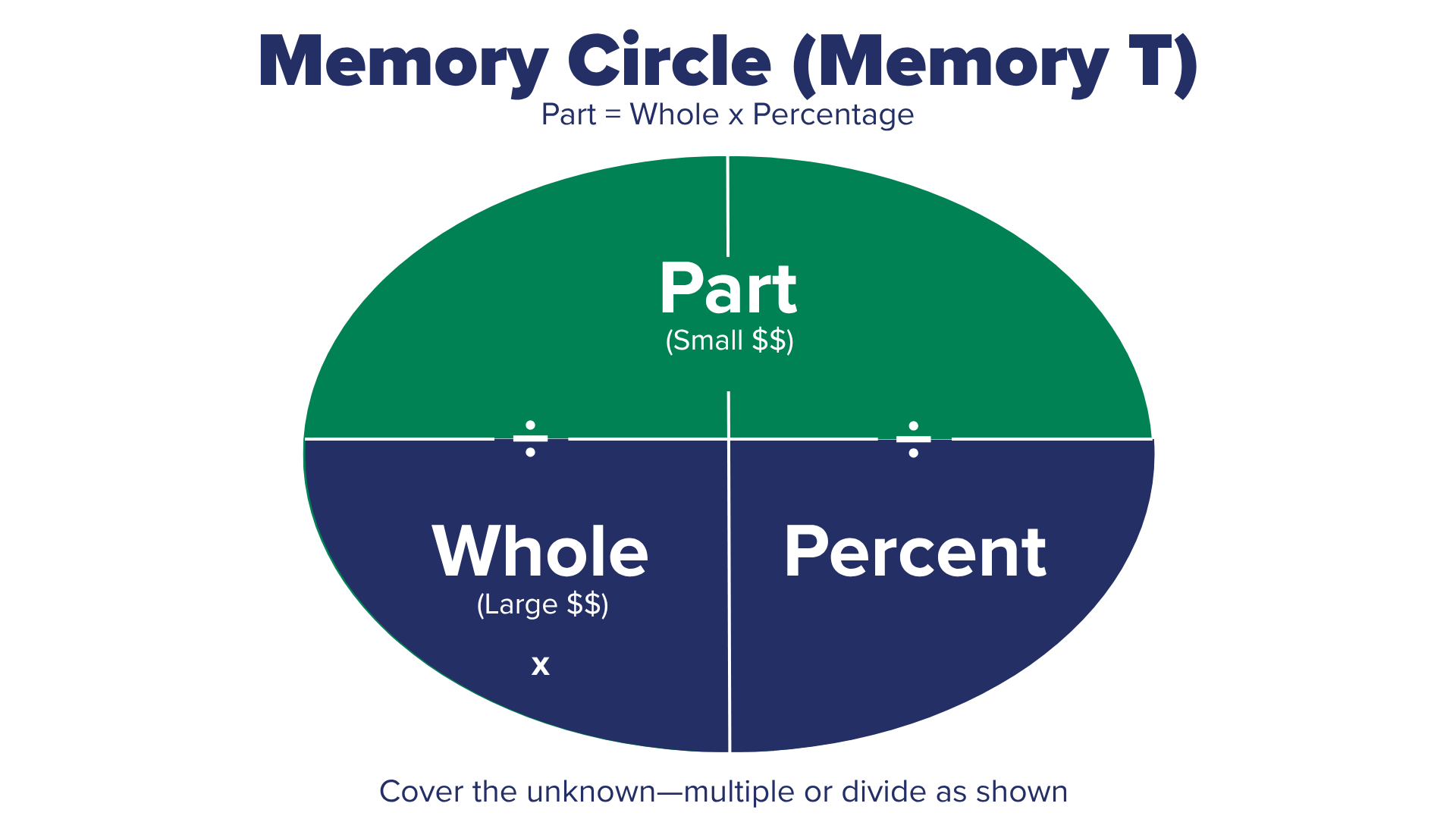
The most common arithmetic error on the exam: entering a percentage as a whole number. 6% into your calculator is 0.06, not 6. Enter it wrong and your answer is off by a factor of 100.
| To convert | Do this | Example |
| % → decimal | Divide by 100 | 6% → 0.06 |
| Decimal → % | Multiply by 100 | 0.0725 → 7.25% |
| Fraction → decimal | Divide top by bottom | 3/8 → 0.375 |
Commission rate of 5.5% → enter 0.055 in your calculator, not 5.5.
| Area Conversions—Memorize These (Not Given on the Exam)
1 acre = 43,560 square feet 1 square mile = 640 acres 1 mile = 5,280 feet Example: These are not provided at the Pearson VUE test center. |
Commission is the most practical math skill you'll use from day one as a licensed agent. In Scottsdale—where the median sale price is around $969,000 (Redfin, April 2026)—commission math isn't just exam prep, it's the arithmetic of your future income. Once you're licensed, use ASREB's free real estate commission calculator.
| Commission Formula
Sale Price × Commission Rate = Total Commission Total Commission × Split % = Party's Commission Working backwards: Agent's Commission ÷ Split % ÷ Rate = Sale Price Example: A $969,000 Scottsdale home at 5.5% commission. |
A Scottsdale home sells for $969,000. The commission rate is 5.5%, split 50/50 between the listing broker and the buyer's broker. That means each broker receives 50% of the total commission. The listing agent then receives 60% of their broker's 50% share—not 60% of the total commission.
Watch for backwards commission problems: the exam gives you the agent's commission and asks for the sale price. Reverse the steps—commission ÷ split % ÷ commission rate = sale price.
| Practice Question 1
A Scottsdale condo sells for $575,000. The commission rate is 5%, split 50/50 between listing and buyer's broker. The listing agent receives 55% of the listing broker's share. What is the listing agent's commission? Answer: $575,000 × 0.05 = $28,750 total. ÷ 2 = $14,375 listing side. × 0.55 = $7,906.25. |
| Practice Question 2
A broker received a commission check for $18,700. The commission rate was 5.5% and the broker kept 100% with no agent split. What was the sale price of the property? Answer: $18,700 ÷ 0.055 = $340,000. |
Proration questions split a prepaid or accrued expense between buyer and seller based on days of ownership. They appear on both exam parts and require careful attention to the day-count rules—the most common source of errors in this category.
In Scottsdale, the median annual property tax bill is approximately $2,573. Here's how the exam tests it:
| Proration Formula
Annual Amount ÷ Days in Year = Daily Rate Daily Rate × Days Owned = Party's Share 360-day (banker's) year: 12 months × 30 days each 365-day (calendar) year: actual days Example: The exam ALWAYS tells you which year and who owns closing day. |
Important rule for Arizona: The Pearson VUE candidate handbook is explicit—every proration question specifies (a) 360 or 365 days, and (b) whether the day of closing belongs to the buyer or seller. Never assume either. Both change your answer.
Taxes for the year are $1,824 and have not yet been paid. Closing is June 7. Assume a 360-day year and the buyer is responsible for the day of closing.
Step 1: Draw a timeline — seller owes from January 1 through June 6 (buyer takes over on June 7).
Step 2: Find days used.
Step 3: Find the cost per day.
Step 4: Find the prorated amount.
Annual property taxes are $3,650 and have not yet been paid. Closing is September 15. The seller is responsible through and including the day of closing. Use a 365-day year.
Step 1: Draw a timeline — seller owes from January 1 through September 15 (inclusive).
Step 2: Find days used.
Step 3: Find the cost per day.
Step 4: Find the prorated amount.
Using the wrong day-count method or misreading who owns closing day are the two most common proration errors. Read the full question before picking up your calculator.
| Practice Question 3
Annual HOA dues on a Scottsdale townhome are $3,600. The seller has prepaid the full year. Closing is August 1. The buyer's ownership begins on closing day. Using a 360-day year, how much does the buyer owe the seller? Answer: Aug 1 through Dec 31 = 5 months × 30 = 150 days. $3,600 ÷ 360 = $10.00/day. $10.00 × 150 = $1,500. |
| Practice Question 4
Scottsdale property taxes are $3,285/year and have not been paid. Closing is May 1. The seller pays through but NOT including closing day. Use a 365-day year. Answer: Jan 1 through Apr 30 = 31+28+31+30 = 120 days. $3,285 ÷ 365 = $9.00/day. $9.00 × 120 = $1,080. |
This category covers three related concepts: loan-to-value ratio, simple interest, and discount points. They're tested separately but all follow the Memory Circle logic—Part = Whole × Percent.
| Loan Financing Formulas
LTV = Loan Amount ÷ Property Value Down Payment = (1 − LTV) × Property Value Simple Interest: I = Principal × Rate × Time Monthly interest = P × R × (1/12) Discount Points: 1 point = 1% of LOAN AMOUNT (not purchase price) Points cost = Loan Amount × (Points × 0.01) Example: Points are on the loan, not the sale price—the most common trap in this category. |
A buyer purchases a Scottsdale home for $850,000 with 10% down. The lender offers a rate buydown requiring 2 discount points. How much will the buyer pay in points at closing?
The trap: some candidates calculate points on $850,000 (purchase price) instead of $765,000 (loan amount). Points are always based on the loan amount.
| Practice Question 5
A buyer purchases a Scottsdale home for $725,000 with 20% down. The lender requires 1.5 discount points. How much will the buyer pay in points? Answer: Loan: $725,000 × 0.80 = $580,000. Points: $580,000 × 0.015 = $8,700. |
| Practice Question 6
A buyer closes on a Scottsdale property on April 15. The loan is $640,000 at 7% annual interest. First mortgage payment is due June 1. The buyer owns closing day. Use a 360-day year. How much prepaid interest is collected at closing? Answer: Daily interest: $640,000 × 0.07 ÷ 360 = $124.44/day. Apr 15–30 = 16 days. $124.44 × 16 = $1,991.11. |
Area questions test square footage, acreage conversions, and price-per-square-foot. In Scottsdale, where the median price per square foot is around $429 (Redfin, April 2026), this math maps directly to real listing valuations. If you want to model income from specific transaction sizes once you're licensed, use ASREB's free real estate commission calculator.
| Property Area Formulas
Area = Length × Width (result in square feet) Acres = Square Feet ÷ 43,560 Price per sq ft = Total Value ÷ Square Footage Total Value = Price per sq ft × Square Footage Irregular (L-shaped) lots: Break into rectangles → calculate each → add or subtract Example: 43,560 sq ft per acre—memorize this. It's not on the exam sheet. |
A rectangular lot in North Scottsdale is 150 feet wide and 290 feet deep. What is the lot size in acres?
A lot in Scottsdale's DC Ranch area has an L-shape. The full rectangle would be 200 feet wide by 150 feet deep, but a 60×80 foot corner is cut out. What is the total square footage and acreage?
| Practice Question 7
A buyer is purchasing a Scottsdale lot at $429/sq ft. The lot measures 120 ft wide by 180 ft deep. What is the total purchase price? Answer: 120 × 180 = 21,600 sq ft. 21,600 × $429 = $9,266,400. |
| Practice Question 8
A Scottsdale property contains 130,680 square feet. How many acres is this? If listed at $200,000 per acre, what is the asking price? Answer: 130,680 ÷ 43,560 = 3 acres. 3 × $200,000 = $600,000. |
Settlement cost questions test what each party owes or receives at closing. The most frequently tested types are prepaid interest (the partial first month collected at closing) and prorated tax or HOA credits. These questions always specify the day-count method and who owns closing day.
| Prepaid Interest at Closing
The lender collects interest from closing day through end of that month. The first full mortgage payment is due the 1st of the SECOND month after closing. Daily interest = Loan × Annual Rate ÷ 360 (or ÷ 365 per question) Prepaid interest = Daily Rate × Days remaining in month Example: Buyer closes March 10 → first payment due May 1 → lender collects March 10–31 at closing. |
A buyer closes on a Scottsdale home on March 10. The loan is $750,000 at 6% annual interest. First payment is due May 1. The buyer owns closing day. Use a 360-day year.
| Practice Question 9
A buyer closes on a Scottsdale condo on September 20. Loan: $480,000 at 7.5% annual interest. First payment due November 1. Buyer owns closing day. 360-day year. How much prepaid interest is collected at closing? Answer: Daily interest: $480,000 × 0.075 ÷ 360 = $100.00/day. Sep 20–30 = 11 days. $100.00 × 11 = $1,100. |
| Practice Question 10
Annual property taxes on a Scottsdale home are $4,745. The seller has not paid them. Closing is June 30. Seller pays through but not including closing day. 365-day year. What does the seller owe at closing? Answer: Jan 1 to Jun 29 = 31+28+31+30+31+29 = 180 days. $4,745 ÷ 365 = $13.00/day. $13.00 × 180 = $2,340. |
Property tax questions require two steps: finding the assessed value from market value, then applying the tax rate. Arizona's system differs from many states—residential properties are assessed at 10% of their Limited Property Value (LPV). The exam will give you the rate; what you need is the sequence.
| Arizona Property Tax Formula
Step 1: Market Value × Assessment Rate = Assessed Value (AZ residential default: 10% of LPV) Step 2: Assessed Value × Mill Rate = Annual Tax (1 mill = $0.001 per $1 of assessed value) (Scottsdale combined rate: ~$0.9124 per $100 AV) Alternatively: AV × (Rate per $100 ÷ 100) Example: $969,000 market value × 10% = $96,900 AV. $96,900 × 0.009124 = $884.12/yr. |
| Practice Question 11
A Scottsdale property has an assessed value of $85,000. The combined mill rate is 91.24 mills. What are the annual property taxes? Answer: $85,000 × 0.09124 = $7,755.40. |
| Practice Question 12
A homeowner pays $2,573/year in property taxes. The mill rate is 91.24 mills. Working backwards, what is the assessed value? Answer: $2,573 ÷ 0.09124 = $28,202.54. |
Investment math covers GRM and cap rate. Property management covers the 28/36 qualifying rule. Both appear in the national exam.
| Investment and Property Management
GRM = Property Price ÷ Gross Annual Rent Cap Rate = NOI ÷ Property Value 28/36 Rule: Gross Income × 0.28 = Max monthly housing cost (PITI) Gross Income × 0.36 = Max monthly total debt Example: GRM uses gross rent. Cap rate uses NOI (net, after expenses). |
| Practice Question 13
A Scottsdale rental property generates $72,000/year in gross rents and is listed at $1,100,000. What is the GRM? Answer: $1,100,000 ÷ $72,000 = 15.28. |
| Practice Question 14
A buyer's gross monthly income is $12,500. Using the 28/36 rule, what is the maximum monthly housing cost (PITI) to qualify for most loans? Answer: $12,500 × 0.28 = $3,500. |
| Practice Question 15
A residential building cost $310,000. Land value is $60,000. Using straight-line depreciation over 27.5 years, what is the annual depreciation? Answer: ($310,000 − $60,000) ÷ 27.5 = $9,090.91/year. |
Every formula category on the Arizona Pearson VUE exam. Save it, print it, use it.
| Category | Formula | Key to memorize |
| Commission | Sale Price × Rate = Total Commission Party's Cut = Total × Split % | Use Memory Circle |
| Proration | Annual ÷ Days × Days Owned = Amount Due | 360 OR 365 — exam tells you |
| Property Area | L × W = Sq Ft | Sq Ft ÷ 43,560 = Acres | 43,560 sq ft = 1 acre |
| Loan / Points | P × R × T = Interest 1 point = 1% of LOAN (not price) | Points on loan, not purchase price |
| Property Tax | MV × Assessment % = AV AV × Mill Rate = Annual Tax | AZ residential: 10% of LPV |
| Investment (GRM) | Property Price ÷ Gross Annual Rent = GRM | Lower GRM = better deal |
| 28/36 Rule | Income × 0.28 = Max housing Income × 0.36 = Max total debt | Housing ≤28%; All debt ≤36% |
| Depreciation | (Cost − Land) ÷ 27.5 = Annual dep. | Residential 27.5 yrs; commercial 39 |
The math formulas above are a start. The exam covers much more—contracts, agency, Arizona statutes, property rights, and 170+ additional questions. Here are the resources to take you from formula practice to exam-day ready:
You've done the hardest part of the math prep. The next step is a pre-licensing program that delivers the rest—and stands behind it with a guarantee no other Arizona real estate school offers.
| Pass or Don't Pay Guarantee
Follow ASREB's recommended study plan and pass the Arizona state exam on your first attempt—or ASREB refunds your first state exam fee. No hoops, no asterisks. Just send your Pearson VUE score report to ASREB. You've just spent time learning every math formula on the exam. The next step is a pre-licensing program that makes sure you show up to the test center ready to use them. |
ASREB students have a 74% first-time pass rate on the Arizona real estate exam—well above the statewide average of around 60%. That gap comes from how ASREB prepares students, not just which students enroll.
55+ years of Arizona real estate education. ASREB has been Arizona's leading real estate school since 1969. The instructors are licensed Arizona real estate professionals—they teach from real-world market experience, not textbooks.
CompuCram exam prep—86.5% first-time pass rate. ASREB students get access to CompuCram: practice tests, a simulated exam that mirrors Pearson VUE's format, a readiness indicator to show you when you're ready, and math review specifically for the calculation sections. Value: $105.
The Crammer Course. An instructor-led live exam prep session reviewing exam questions, testing strategies, and key terminology—including every math category in this guide. Value: $99.
Your format, your schedule. Self-paced online, livestream, or in-person classroom. Mix and match as you go. Complete the 90-hour pre-licensing requirement on a timeline that works around your current job and life.
Career support beyond the exam. Career Nights, the Broker Marketplace, a Broker Interviewing Skills Workshop, and 18 hours of continuing education included at no extra charge for the first renewal cycle.
Get started: View ASREB pre-licensing course options | Explore exam prep
The national/general portion includes 7 dedicated math questions (one per category). The Arizona state exam adds further math, bringing the combined total to approximately 11 math questions across the full 195-question exam (180 scored, 15 unscored pretest items).
Yes. Pearson VUE allows a battery-operated, non-printing, silent calculator without an alphabetic keypad. Approved models include the HP 10BII, HP 10, HP 12C, Real Estate Qualifier Plus IIIX, and Real Estate Mortgage Qualifier Plus. Smartphones are not permitted.
The 360-day banker's year treats every month as exactly 30 days. The 365-day calendar year uses actual day counts. The Arizona Pearson VUE exam will always specify which method to use within the question. Using the wrong method gives a different answer even with perfect arithmetic.
Arizona assesses residential properties at 10% of their Limited Property Value (LPV), which is capped at a maximum 5% annual increase regardless of market appreciation. This means assessed values can be significantly below market value in fast-appreciating areas like Scottsdale. On the exam, you'll be given the assessed value or assessment rate—the calculation sequence is the same.
Discount points are upfront fees paid to reduce a loan's interest rate. One point equals 1% of the loan amount—not the purchase price. Calculate the loan amount first (purchase price minus down payment), then multiply by the number of points as a percentage. Calculating on the purchase price instead of the loan amount is the most common error in this category.
If you follow ASREB's recommended study plan and don't pass the Arizona state exam on your first attempt, ASREB refunds your first state exam fee. Send your Pearson VUE score report to ASREB to claim the refund. Learn more about our Pass or Don't Pay Guarantee.
75%—135 of 180 scored questions correct.
Yes. ASREB's pre-licensing and exam prep courses cover all math categories tested by Pearson VUE, with AZ-specific worked examples and practice problems through the CompuCram platform. There is also a dedicated math review session available. View exam prep options.