Beyond the Price Tag: Understanding Custom Homes and Luxury Architecture
Real Estate Tips
What makes a home luxurious?
Ask ten people that question, and I suspect you'll get ten different answers. Some will point to square footage, imported finishes, or elaborate architectural features. Others might describe an incredible mountain view, a thoughtfully designed outdoor space, or a home that simply feels right the moment they walk through the door.
That's what makes luxury real estate such an interesting part of our industry. We can measure square footage, evaluate construction materials, and compare market prices, but some of the things people appreciate most about a home are much harder to quantify.
After years in Arizona real estate, I've come to appreciate that the conversation surrounding custom homes and luxury architecture is about more than expensive properties. It's about the relationship between design, personal preferences, the surrounding environment, and the decisions that ultimately shape how a home looks and functions.
And occasionally, it's about questioning what we think luxury is supposed to look like.
There's an assumption in real estate that a custom home must somehow be superior to a production-built property. I don't necessarily agree.
Production homes generally rely on established floor plans, standardized construction processes, and predetermined design options. Semi-custom homes introduce varying degrees of flexibility, allowing buyers to personalize certain structural features, layouts, and finishes.
Fully custom homes generally begin with a different process. Rather than choosing from an existing collection of designs, the homeowner works with architectural and construction professionals to develop something specific to their needs and property.
Each approach has advantages.
A production builder may have spent years refining a floor plan and construction process. A custom builder may be able to accommodate architectural details or site conditions that would be impractical within a production development.
Neither approach guarantees a better result.
I think this distinction matters because we sometimes confuse the degree of customization with the quality of construction. Those are two very different considerations.
A custom home can be extraordinary. It can also be poorly designed or constructed. Similarly, a thoughtfully executed production home can offer outstanding craftsmanship and functionality.
What makes custom architecture interesting to me isn't the assumption that it must be better. It's the freedom to create something different.
One of the things I appreciate about Arizona real estate is the architectural diversity found throughout our state.
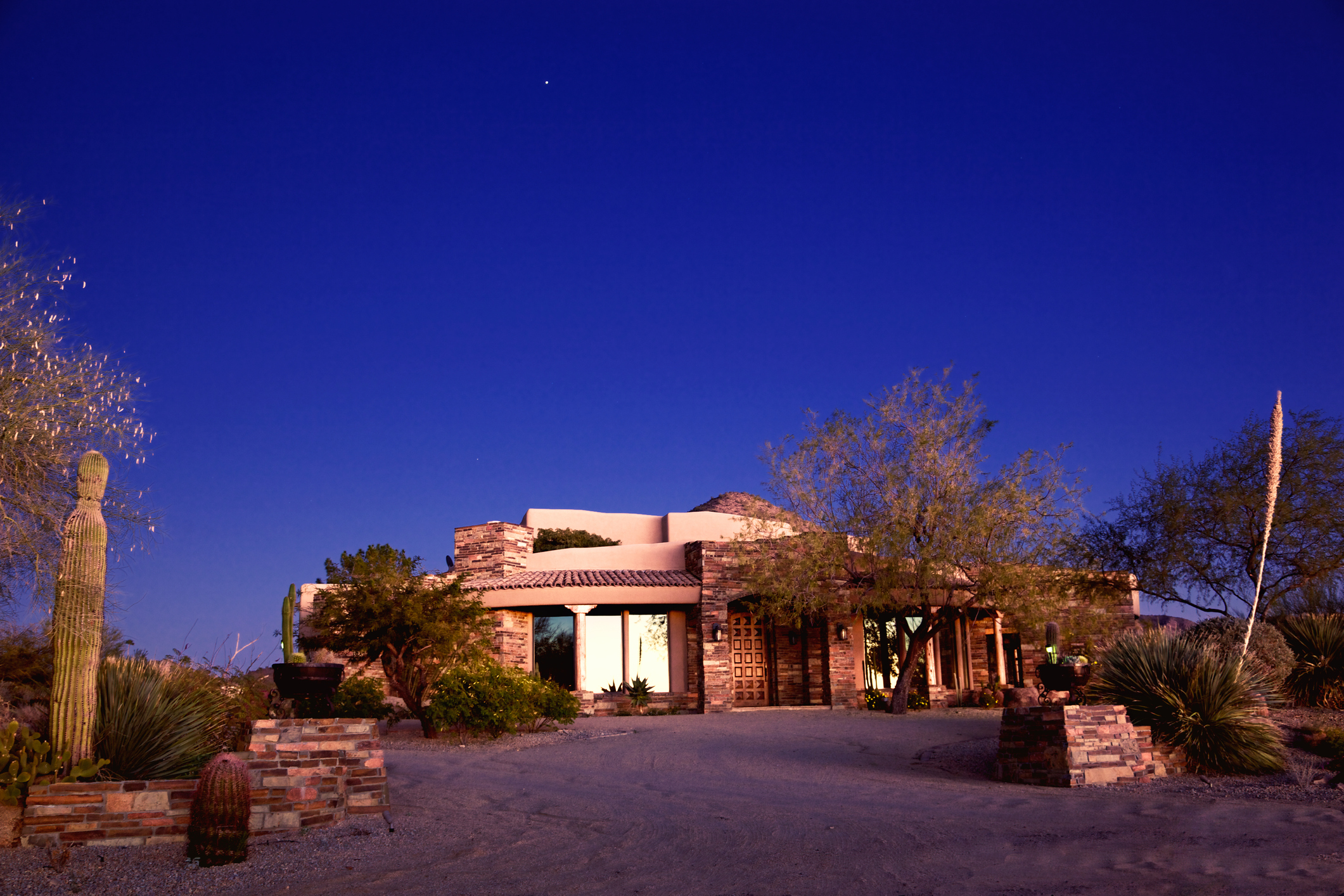
Contemporary desert architecture, territorial homes, Mediterranean-inspired estates, and modern residences with expansive walls of glass can all exist within relatively close proximity.
Our environment creates incredible design opportunities, but it also presents challenges.
Take those beautiful floor-to-ceiling windows overlooking the mountains. They can create a dramatic connection between a home's interior and the surrounding desert. However, their performance depends on much more than their appearance.
The U.S. Department of Energy identifies U-factor and Solar Heat Gain Coefficient (SHGC) as two important measures of window energy performance. U-factor measures heat transfer, while SHGC measures the amount of solar radiation passing through the glass. In warm climates, lower SHGC values generally help reduce unwanted solar heat gain.
That becomes particularly relevant when considering large expanses of glass in Arizona.
A west-facing window may capture an incredible sunset, but it can also introduce substantial afternoon heat. Proper glazing, shading, building orientation, and mechanical design can influence how that decision affects the home's comfort and performance.
Does that mean we should avoid west-facing glass? Of course not.
It means architecture involves trade-offs.
The same applies to courtyards, roof overhangs, outdoor living areas, and the materials selected for construction.
I find it interesting how the most visually impressive architectural feature isn't always the most technically complicated, and some of the most important design decisions are barely noticeable once construction is complete.
Understanding those decisions can give us an entirely different appreciation for a property.
For a long time, size seemed to be one of the most recognizable characteristics of luxury housing.
Larger homes, expansive formal rooms, oversized garages, and elaborate entertaining areas were frequently associated with the upper end of the residential market.
Those features certainly haven't disappeared, but buyer preferences continue to evolve.
The American Institute of Architects' September 2026 Home Design Trends Survey identified increasing interest in outdoor living areas, multifunctional rooms, accommodations for multiple generations, and accessible design features such as first-floor primary suites and wider doorways.
I find these trends particularly interesting because they suggest homeowners are thinking carefully about how their spaces will function, both today and in the future.
Consider a traditional formal dining room compared with a flexible living space that can accommodate entertaining, work, or extended family.
Which is more desirable?
That depends on the person purchasing the home.
For someone who regularly hosts large family gatherings, a formal dining room might be essential. Another buyer may see little purpose in dedicating that much square footage to a room they rarely use.
The same applies to home theaters, wine cellars, fitness studios, guest suites, and outdoor kitchens.
I would argue that one of the defining characteristics of custom architecture is the opportunity to design around individual priorities rather than a universal expectation of what a home should include.
And that may be one of the most interesting ways the definition of luxury is evolving.
Some of Arizona's most distinctive custom homes are impressive not simply because of the structures themselves, but because of the relationship between the architecture and the land.
Properties positioned along mountain slopes, overlooking natural desert landscapes, or incorporating unusual topography present opportunities that don't always exist on conventional residential lots.
They can also introduce substantial construction challenges.
Hillside development may involve specialized foundations, retaining structures, grading considerations, drainage engineering, and complex utility installations.
Local regulations can also significantly influence how a property may be developed.
For example, Scottsdale's Environmentally Sensitive Lands Overlay establishes requirements intended to protect natural desert features, including washes, mountain ridges, native vegetation, and environmentally sensitive areas. Depending on the location and characteristics of a property, portions of the land may need to remain preserved as Natural Area Open Space.
That means owning several acres doesn't necessarily mean having the ability to build on every portion of them.
I think this is an important consideration for both buyers and real estate professionals.
It's easy to fall in love with a spectacular homesite. Understanding what can actually be constructed on that property requires a different level of investigation.
Architects, engineers, surveyors, builders, and local planning departments can all play important roles in determining what is feasible.
And sometimes, the limitations of a particular property are exactly what inspire an interesting architectural solution.
Here's where the conversation gets particularly interesting from a real estate perspective.
Imagine a homeowner spends a substantial amount of money creating a highly customized residence. They incorporate imported materials, specialized finishes, extensive automation, and architectural features selected specifically for their lifestyle.
Those decisions may create exactly the home they envisioned.
But does every dollar spent translate into an equivalent increase in market value?
Not necessarily.
Custom homes present unique valuation challenges, particularly when comparable properties are limited or when certain improvements are uncommon within a particular market.
Appraisers rely on market evidence and recognized valuation methodologies rather than simply adding together the cost of construction and upgrades.
The Appraisal Institute has discussed the importance of the cost approach in evaluating unique properties, particularly when comparable sales are difficult to identify. Even then, construction cost and market value are not automatically equal.
This distinction is something I think our industry should recognize more consistently.
A feature can be expensive without being universally desirable. It can also be highly desirable to a particular buyer without having a readily measurable contribution to market value.
I don't believe we should discourage homeowners from personalizing their properties. Quite the opposite. Creating a home around individual preferences is one of the most appealing aspects of custom construction.
But personal enjoyment and market-supported value are different considerations.
Both matter. They just shouldn't be confused.
When we tour a completed luxury home, it's easy to focus on the finished product.
What we don't always see is the coordination required to make it happen.
Architects, engineers, builders, designers, landscape professionals, specialty contractors, and numerous other trades may contribute to a custom residence.
Their work involves far more than aesthetics.
A large open living area may require specialized structural engineering. Extensive glass can influence energy and mechanical design. Unique materials may present installation and maintenance considerations that differ from conventional construction.
Even relatively small changes during construction can affect budgets, timelines, and other components of a project.
The Arizona Registrar of Contractors recommends that consumers verify contractor licensing, confirm that the license classification covers the proposed work, review references, and establish clear written agreements addressing the scope of construction.
These considerations aren't particularly glamorous, but they are important.
I believe one of the strengths of our real estate industry is the range of professionals who contribute their expertise to a transaction or construction project.
Agents don't need to become architects, and architects don't need to become real estate agents. What matters is understanding where our knowledge ends and when the expertise of another professional becomes essential.
That type of collaboration benefits everyone involved.
The next time you walk through a custom home, consider looking at it from a slightly different perspective.
Rather than immediately focusing on the price tag or the finishes, ask yourself why the home was designed the way it was.
Why did the architect place the main living area in that particular location? How does the home interact with the surrounding landscape? What purpose does an unusual architectural feature serve? Which design decisions seem to reflect the personality or priorities of the original owner?
You might discover an appreciation for features that initially seemed unremarkable. You might also find yourself questioning decisions that look impressive but wouldn't necessarily suit your own lifestyle.
Neither reaction is wrong.
Real estate is interesting because every property is different, and the people purchasing those properties are even more so.
From my perspective, that's something worth remembering as our industry continues to evolve.
We can study architectural trends, construction techniques, building performance, and market behavior. Those are all valuable tools for understanding real estate.
But we should be careful not to confuse our personal preferences with universal standards.
The most expensive home isn't automatically the most thoughtfully designed. The largest home isn't necessarily the most functional. And the architectural features that appeal to one buyer may be completely unimportant to another.
Custom architecture gives people an opportunity to express their individuality through the places they live.
We don't all have to appreciate the same designs, finishes, or floor plans.
In fact, I think real estate would be considerably less interesting if we did.