What’s on the Arizona Real Estate Exam? The Complete 2026 Guide
Exam Prep
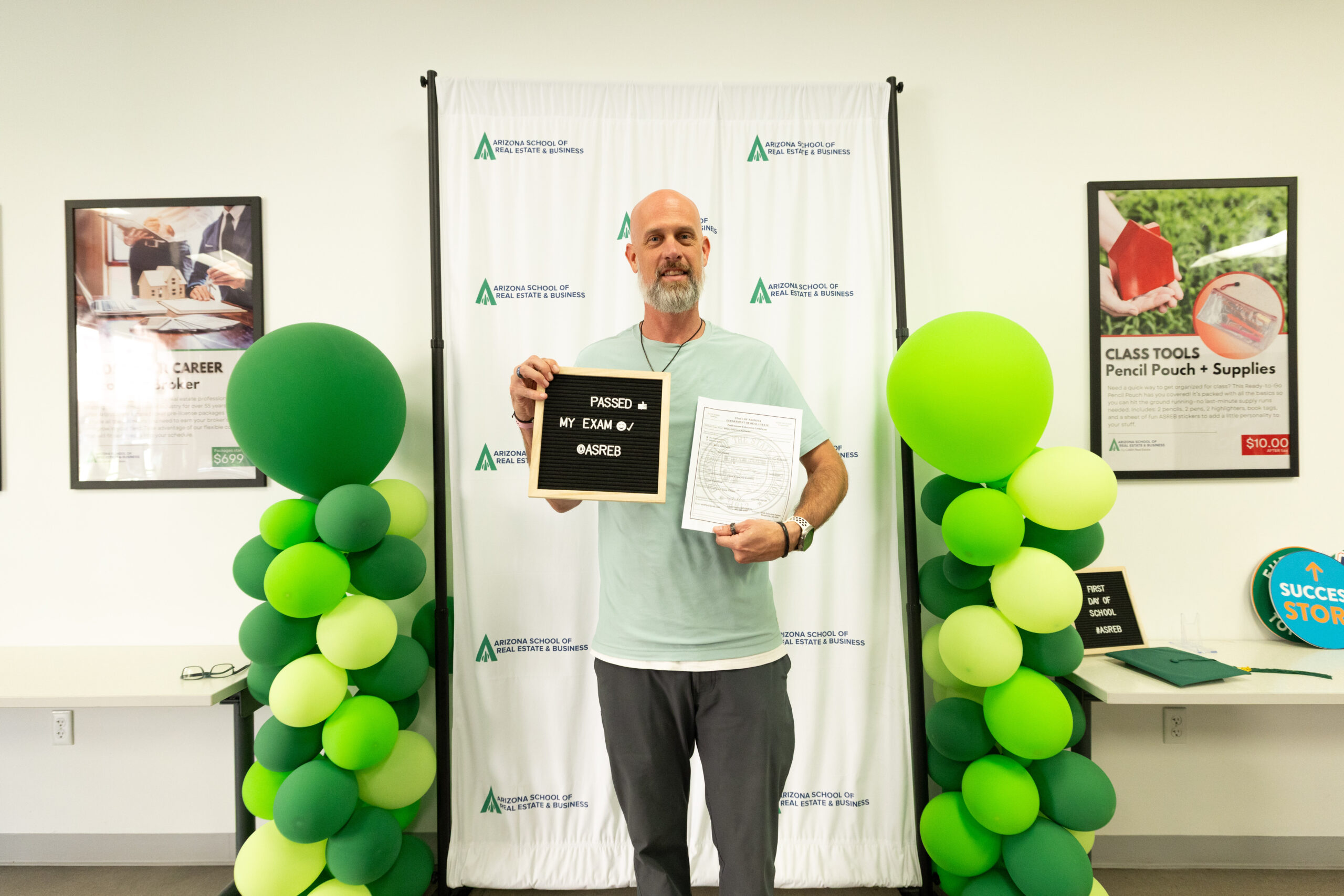
If you're preparing for the Arizona real estate salesperson exam, one question comes before all the study guides, practice tests, and flashcards: what exactly is on it? This guide breaks it down completely — every topic category, the updated 2026 exam structure, scoring rules, what to bring on exam day, and how Arizona's most trusted real estate school prepares you to pass on the first try.
Effective January 2026, the Arizona Real Estate Salesperson exam is no longer administered as a single unified test. Pearson VUE now scores it as two distinct portions:
You must pass both portions to qualify for licensure. If you pass one and fail the other, you only need to retake the portion you failed — you do not have to retake the one you passed. This is a significant change from the prior format and affects how smart candidates should structure their study time.
Why this matters: Under the old format, weakness in any single topic area could be masked by strength elsewhere. Under the two-portion model, you must demonstrate competency in both general principles AND Arizona-specific law independently. Prep programs that teach exclusively from national curricula — without deep Arizona law knowledge — leave students exposed on the state portion.
For the most current question counts, time limits, and passing scores for each portion, download the official Pearson VUE Arizona Real Estate Candidate Handbook at home.pearsonvue.com/az/realestate.
The Arizona real estate exam is built around 27 content areas established by Pearson VUE. Both portions draw from this list — the table below shows which portion each topic primarily tests. Note that some general principles topics may appear in the state portion when they intersect with Arizona-specific law.
| # | Topic | Exam Portion |
|---|---|---|
| 1 | Real Estate Statutes — Arizona Constitution, federal and state law governing brokers and salespersons | State (AZ) |
| 2 | Licensing Requirements — education, examination, and compliance for obtaining and maintaining a license in Arizona | State (AZ) |
| 3 | Regulation of Real Estate — ADRE, the advisory board, and commissioner authority | State (AZ) |
| 4 | Brokerage Operations — office management, record-keeping, and regulatory compliance | General |
| 5 | Agency Relationships — types of agency, duties of agents to clients and customers | General |
| 6 | Contract Law — formation, types, enforceability, and voidability of real estate contracts | General |
| 7 | Property Ownership — types of property interests, co-ownership, condominiums, and legal descriptions | General |
| 8 | Government Rights in Real Property — eminent domain, taxation, and police power | General |
| 9 | Land Use and Zoning — zoning laws, environmental regulations, and land development | General |
| 10 | Real Estate Finance — loan types, mortgage market, and government loan programs | General |
| 11 | Valuation and Appraisal — approaches to property valuation and the appraisal process | General |
| 12 | Real Estate Investments — principles, analysis, and taxation of investment properties | General |
| 13 | Income Tax Aspects of Real Estate — deductions, capital gains, and special tax considerations | General |
| 14 | Water Law — Arizona-specific water rights, doctrines, and the Groundwater Act | State (AZ) |
| 15 | Environmental Law — pollution, hazardous materials, and protected areas affecting real estate | General |
| 16 | Land Descriptions — metes and bounds, public land survey system, and legal descriptions | General |
| 17 | Encumbrances — liens, easements, and other factors affecting property titles | General |
| 18 | Title Transfer — deeds, closing process, and legal requirements for transferring ownership | General |
| 19 | Leasing and Property Management — lease fundamentals, tenant-landlord law, and PM responsibilities | General |
| 20 | Escrow and Settlement — the escrow process, escrow agents, and settlement statements | State (AZ) |
| 21 | Fair Housing — anti-discrimination laws and equal opportunity obligations | General |
| 22 | Financing Documents — promissory notes, mortgages, and deeds of trust | General |
| 23 | Math Calculations — prorations, commission calculations, and loan-to-value ratios | General |
| 24 | Special Topics — timeshares, land development, and new home sales | General |
| 25 | Professional Practices — ethics, professional standards, and continuing education obligations | General |
| 26 | Risk Management — identifying and managing risk in real estate transactions | General |
| 27 | Technology and Real Estate — digital tools, online listings, e-signatures, and CRM platforms | General |
Real Estate Statutes. You'll need to know the sources of Arizona real estate law — the Arizona Constitution, A.R.S. Title 32 Chapter 20, federal statutes, and how they govern broker and salesperson conduct. This isn't abstract: the exam tests specific statutory provisions, including what requires a license, what actions constitute violations, and what disclosures are mandatory.
Water Law. This is unique to Arizona and consistently catches out-of-state study materials off-guard. Arizona is an appropriation-doctrine state, not a riparian rights state. You need to understand the prior appropriation doctrine, the Arizona Groundwater Management Act of 1980, the five Active Management Areas (AMAs), and how the Assured Water Supply program affects residential development and disclosure obligations. No other state tests this — it's a pure AZ differentiator.
ADRE Regulation. Expect questions on the Commissioner's authority, advisory board composition, grounds for license revocation, and the Recovery Fund. Know the difference between what the Commissioner can do administratively versus what requires a judicial proceeding.
Agency Relationships. The exam tests more than just the definition of agency — it tests the duties of loyalty, obedience, disclosure, confidentiality, accounting, and reasonable care in applied scenarios. You'll see questions where you must identify which duty was breached in a fact pattern.
Contract Law. Know the essential elements of a valid contract, the difference between void and voidable contracts, what constitutes an offer and acceptance, statute of frauds requirements for real estate, and what happens upon breach. The exam frequently tests liquidated damages and earnest money forfeiture scenarios.
Real Estate Finance. This covers loan types (conventional, FHA, VA, USDA), the secondary mortgage market, qualifying ratios, Truth in Lending, RESPA, and anti-predatory lending laws. Expect math questions on calculating loan amounts, monthly payments, and points.
Math Calculations. Math is its own topic category and appears throughout the exam. Commonly tested calculations include commission splits, prorations (taxes, rent, HOA dues), loan-to-value ratios, capitalization rates, and area calculations. A four-function calculator is permitted — know when to use it.
You must complete the required 90-hour pre-licensing education and receive your Prelicensure Education Certificate before you can schedule the exam. Note that the 6-hour Contract Writing Course (CWC) is not required to sit for the exam — but it IS required before your license can be issued, and it provides valuable contract knowledge that shows up on the state exam. Most instructors recommend completing it before testing.
No study materials, phones, or personal items are allowed in the testing area. Pearson VUE provides scratch paper and a pencil at the testing station.
Aim to arrive 30 minutes before your scheduled time. Late arrivals may be turned away and forfeit their exam fee. The check-in process includes photo capture, palm vein scan, and signing the Candidate Rules Agreement. Ready to book? Schedule your exam here.
The exam is administered on a computer. You'll have time to complete a brief tutorial on the testing software before the clock starts — use it. You can flag questions for review and return to them before submitting each portion.
You receive your score immediately upon completing each portion. Passing requires a score of 75% or higher on each portion. Your score report will show the number of questions answered correctly and a performance breakdown by topic area — if you need to retake a portion, this breakdown tells you exactly where to focus.
You must wait 24 hours before scheduling a retake. There is no limit on the number of retakes, but each attempt requires payment of the exam fee. Under the two-portion format, you only retake the portion(s) you did not pass — not both.
ASREB note: 74% of ASREB students pass on their first attempt, compared to 64% at all other Arizona schools per ADRE data. If you don't pass after completing an ASREB prep program, we'll refund your exam fee — that's our Pass or Don't Pay Guarantee.
Because the exam is now two separate scored portions, build two parallel study tracks from the beginning:
Per Pearson VUE's content outline, the topics that carry the most exam weight are also the ones with the most nuanced fact patterns: Agency Relationships, Contract Law, Finance, and Arizona Statutes. A wrong answer on these topics is statistically more costly than a wrong answer on a smaller section. Prioritize mastery, not just familiarity.
Real estate vocabulary is the hidden hurdle for most exam failures. Terms like "deed" versus "deed of trust," "warranty deed" versus "quitclaim deed," or "actual notice" versus "constructive notice" can each be the pivot point of an exam question. If you know the concept but not the term, you'll miss the question.
Time management matters. Take full-length timed practice exams in a quiet space without interruption. Track your per-question pace and identify the topics where you slow down — those are your weak spots.
ASREB has been Arizona's leading real estate school since 1969 — over 55 years of preparing students specifically for the Arizona exam. The distinction matters: our instructors are Arizona-licensed professionals with decades of local market knowledge, not generic course developers writing to a national curriculum. When the state portion tests Arizona-specific water law or ADRE procedures, ASREB students know it.
ASREB offers multiple exam prep formats so you can study in whatever way actually works for you:
CompuCram® Exam Prep — $105
The most comprehensive self-paced option. CompuCram includes guided or self-directed study paths, a Readiness Indicator that tells you when you're statistically ready to pass, practice tests, simulated full exams that mirror the real testing environment, vocabulary tools, and questions written by local Arizona experts. Mobile-friendly so you can study anywhere.
Basic Licensing Review Crammer — $99
An 8-hour live streaming session covering the most heavily tested exam topics. Instructors walk through practice questions in real time, teach test-taking strategy and question structure, and help you identify traps built into how questions are worded. Ideal if you learn better in a live setting than from self-paced software.
Real Estate Math Review — $59
Live streaming session focused entirely on the Math Calculations topic — prorations, commissions, loan math, area calculations. If math is your weakest topic, this session directly targets it in a live instruction format.
Livestream Real Estate Tutoring — $60/session
One-on-one sessions via Zoom with your choice of instructor. Available in 1-hour or 2-hour blocks. Best if you have specific topic gaps you need to work through with direct instructor feedback rather than a group setting.
Online Vocabulary Flashcards — $25 (90-day access)
Digital flashcard system covering real estate vocabulary — the critical gap between knowing concepts and being able to identify them under exam pressure.
Arizona Real Estate Flashcards — $39.95 (physical)
600-term hardcopy flashcard set covering Arizona-specific vocabulary alongside general real estate terms. Use these during commutes, breaks, or anywhere screen time isn't practical.
View all exam prep options and current schedules →
The gap isn't accidental. It comes from three structural advantages:
Arizona-specific instruction, not national curriculum. ASREB instructors know the ADRE, know Arizona water law, know the state's escrow process. Students don't encounter Arizona-specific exam questions cold — they've already been taught to think in Arizona's regulatory context.
55+ years of Arizona exam intelligence. Founded in 1969, ASREB has tracked how the Arizona exam has changed across decades. We've seen content shifts, format changes, and recurring question patterns. That institutional knowledge is embedded in every prep product we offer.
Multiple formats that match how different people learn. CompuCram for self-paced digital learners. Live streaming for those who need structure. One-on-one tutoring for targeted gap-filling. Physical flashcards for tactile learners. Most schools offer one approach. ASREB offers all of them.
Pass or Don't Pay Guarantee: If you complete an ASREB prep program and don't pass, send us your score report and we'll refund your exam fee. We back our preparation with a guarantee because 74% of students don't need it.
Learn more about why students choose ASREB
The exam is a gate, not a destination. Here's what three ASREB graduates built after passing:
Courtney Bullock: After 20 years in financial services, Courtney made the switch to real estate. In her first year with RE/MAX Cornerstone, she was recognized as a national Rookie of the Year finalist by RISMedia — a recognition reserved for first-year agents with exceptional production.
Derek Tschilar: Eight years in automotive sales. Passed the Arizona exam. Joined Realty One Group. Sold 20 units totaling more than $7 million in volume in his first year and was named Real Estate Rookie of the Year in Arizona.
Paul Haley: Got licensed right out of high school at 20 years old. Joined eXp Realty. Completed $8.8 million in transaction volume.
Read more student success stories
The General portion (ReAZ-Sales-GE) tests real estate principles that apply nationally — agency law, contract law, financing, fair housing, and appraisal. The State portion (ReAZ-Sales-S) tests Arizona-specific law — ADRE regulations, Arizona statutes, water rights, escrow rules, and the Commissioner's authority. You must pass both with a score of 75% or higher.
Yes. Both portions are typically scheduled for the same testing session. If you fail one and pass the other, you only need to retake the failed portion — you won't have to sit for the one you passed again.
For the most current question counts per portion, download the Pearson VUE Arizona Real Estate Candidate Handbook — counts are subject to change when Pearson VUE updates the content outline, as they did in January 2026.
75% or higher on each portion. You receive your score immediately upon completing the exam.
You can retake the failed portion after a 24-hour waiting period. There's no limit on retakes, but each attempt requires payment of the exam fee. ASREB's Pass or Don't Pay Guarantee means if you completed our prep and don't pass, we'll refund your exam fee.
No — the CWC is not required to sit for the salesperson exam. However, it IS required before your license can be issued, and it teaches contract law that appears on the exam. Most instructors recommend completing it beforehand. See ASREB's pre-licensing courses.
Vocabulary and Arizona-specific law are the most common failure points. Many candidates who understand real estate concepts in principle still miss questions because they don't know the precise legal term. Arizona's water law, ADRE authority, and escrow-specific regulations also trip up candidates who used out-of-state or generic national study materials.
Most candidates need 2–4 weeks of dedicated study after completing their 90-hour pre-licensing coursework. The timeline depends on your background, how much time you can commit daily, and which format you use. CompuCram's Readiness Indicator gives you a data-driven signal for when you're statistically ready — don't rely on gut feel.
ASREB offers the full range of exam prep formats — CompuCram, live stream crammer sessions, one-on-one tutoring, and flashcards — all designed specifically for the Arizona exam. With the highest first-time pass rate in the state and a Pass or Don't Pay Guarantee, there's no better place to prepare.